Choosing Your First Marine Compass: Handheld vs. Binocular vs. Fixed-Mount
Stand at the helm of a small sloop with three compasses within reach and you may still wonder which one to trust. That uncertainty usually has little to do with quality. It is about purpose. A hand bearing compass, a compass built into a pair of binoculars, and a fixed steering compass solve three different problems, and buying them in the wrong order is one of the most common ways new navigators spend money twice. The choice becomes simple once you match the instrument to the work you actually do on deck: holding a course, taking a bearing, or identifying a distant mark.
Start With the Job, Not the Brand
Before you read a single specification, describe your typical day. If you sail from a harbour you know, follow a line of buoys and mostly steer by eye, a fixed compass plus a cheap handheld will carry you a long way. If you crew on other people's boats, eat lunch at a different anchorage each day and are often asked "what's the bearing to that headland?", the handheld becomes your personal tool and should travel in your bag. If you spend long hours watching shipping lanes and trying to pick out a harbour entrance in haze, binoculars with a compass earn their space.
One distinction worth fixing in your head early: the GPS on your plotter shows course over ground, the direction the boat actually travelled. A compass shows heading, the direction the bow points. In a cross-current those two numbers can differ by twenty degrees or more, and the gap is exactly where beginners get confused.
Handheld Bearing Compasses
What they do well
A hand bearing compass answers one question quickly: what is the bearing to that object? You raise it to eye level, sight over the notch or vane, and read the card through the prism or lens. Three bearings to charted landmarks, noted with the time, give you a fix you can plot on paper in under a minute. Two bearings to a buoy and a headland are enough to check whether your track is drifting toward a shoal. On a small boat with no electronics, that routine is your navigation.
Good ones share a few traits. The card is damped so it settles fast rather than swinging for ten seconds. Graduations are clear at a glance, ideally every two degrees with bold figures at tens. The body fits your hand and your eye socket, which matters more than it sounds when the boat is rolling. A lanyard is not optional; a compass dropped over the side is gone.
- Look for: a prism or lens you can focus, a card that settles in two or three seconds, and a body that blocks stray light from the card.
- Check: graduations, night illumination if you sail after dark, and whether you can hold it steady with one hand while bracing against a shroud.
- Avoid: storing it beside a phone, a VHF handset, a knife with a magnet in the sheath, or a speaker. These will pull the card and you will not notice.
Where they fall short
Accuracy is realistic, not laboratory-precise. Expect readings within a few degrees when you are steady and braced, and wider scatter in a short chop when the horizon is moving. That is fine for pilotage and rough fixes, and hopeless for steering a long ocean leg. A hand bearing compass is also useless as a steering reference because you cannot hold it and the tiller at the same time.
Binocular Compasses
These combine two jobs that belong together. You spot a mark through the lenses, and the bearing appears in the same field of view, read against an internal compass rose. Instead of lowering binoculars, raising a compass, and hoping you are looking at the same object, you read the number while the object is still centred in the eyepiece. For harbour entrances, unlit buoys at dusk, and identifying which of three similar churches is the one on your chart, this is a genuine convenience.
The trade-offs are real. Compass binoculars are heavier than plain ones, and at seven-fold magnification a moving deck makes steady viewing hard work; the compass reading suffers first. The internal compass needs light to be readable at night, so check the illumination before you buy. The module also sits inside a housing full of metal and electronics, which means it should be checked against a known bearing, ideally more than once a season, and recalibrated if your manual describes a procedure. Some models require you to set the local magnetic variation; get that wrong and every bearing will be off by the same amount.
My advice for a first purchase is to wait. Buy a decent handheld, borrow binoculars, and notice whether you actually spend your time identifying distant objects or whether you mostly take bearings close to the boat. Compass binoculars reward the first habit and are dead weight for the second.
Fixed-Mount Compasses
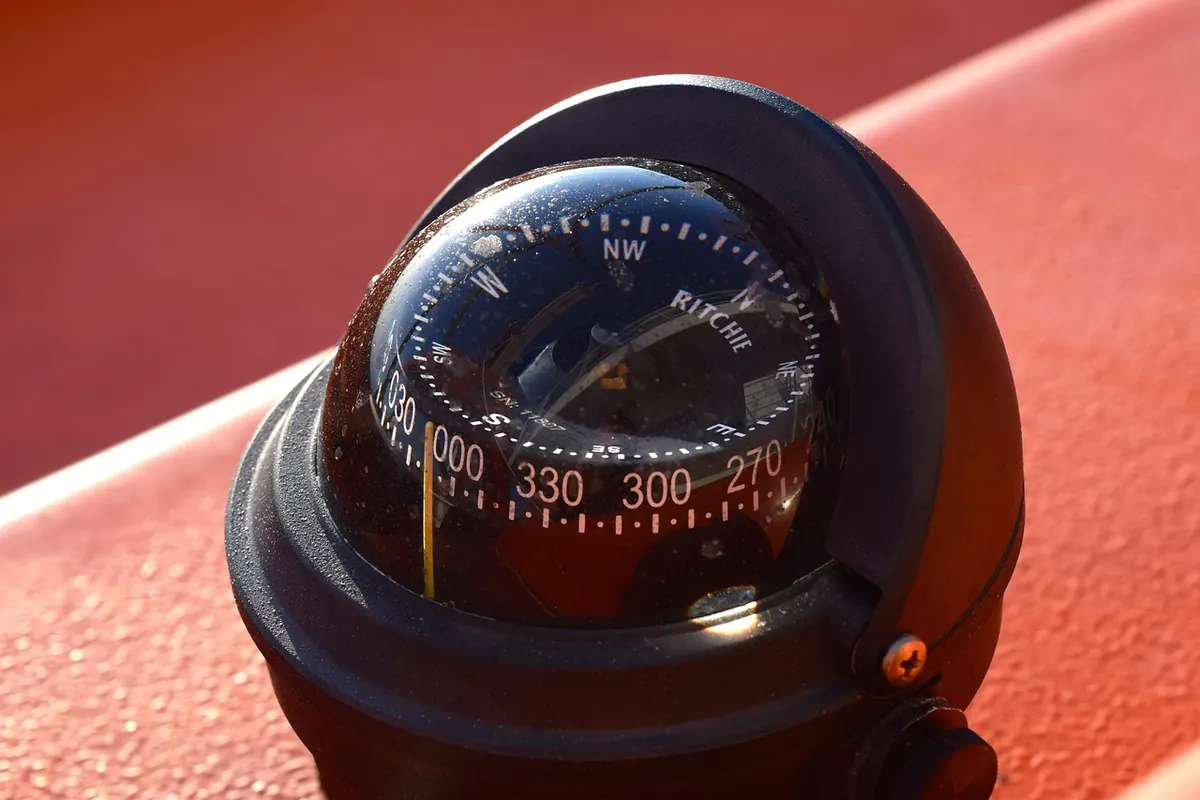
This is the one you steer by. Mounted on a bulkhead, a binnacle or the console, with a large card visible from the helm and a lubber line to read against, it gives a stable reference through hours of course-keeping. Larger cards are easier to read in a seaway, which matters more than most buyers expect. Illumination, a sunshade and decent damping separate a pleasant instrument from a tiring one.
A compass tells you where the bow points, not where the boat is going. Knowing the difference is half of navigation.
Mounting and deviation
Placement decides whether the instrument is useful. Keep it away from the VHF, the plotter, speakers, electric motors, heavy wiring runs, the engine, anchors and any steel rigging. If you must mount near electronics, respect the safe distance in the manual rather than guessing. On a steel boat, this problem becomes a project of its own and deserves professional attention.
Once mounted, the compass needs a deviation check: a slow turn through the cardinal points while comparing the compass against a known bearing, recording the error on each heading. A small deviation card taped beside the instrument is normal practice and takes an afternoon. Do not confuse deviation, caused by magnetism on your own boat, with variation, the difference between magnetic and true north printed on the chart or chartplotter. Both corrections belong in your working habits.
Electronic fluxgate and solid-state heading sensors are worth considering if you want heading fed to a plotter, an autopilot or a radar overlay. A magnetic card with a glass dome remains the simplest thing to trust when the power fails, which is a good reason to keep one aboard.
Comparing the Three at a Glance
- Best for: handheld — pilotage, bearings and quick fixes; binocular — identifying distant marks and reading their bearing; fixed-mount — steering and holding a course.
- Typical accuracy in practice: handheld and binocular within a few degrees when braced; fixed-mount limited more by deviation and steering skill than by the card.
- Mounting: handheld — none, held in the hand; binocular — none, but heavier to hold steady; fixed-mount — permanent, and placement is the whole job.
- Beginner suitability: handheld — first purchase; fixed-mount — essential if you own the boat; binocular — second purchase, once you know your habits.
- Main maintenance task: handheld — keep it away from magnets and check for bubbles; binocular — verify calibration; fixed-mount — a deviation card and a clean dome.
A Sensible Buying Order for a First Season
- Buy a handheld bearing compass and use it weekly until raising it to your eye is automatic.
- Check the fixed compass on the boat you sail. If it has bubbles, a clouded dome or sits beside a speaker, raise it with the owner before you rely on it.
- Learn to plot a three-bearing fix on paper, with times noted, before you touch a chartplotter.
- Borrow compass binoculars for one passage in poor visibility, then decide.
- Only after that, spend on the upgrade that matches what you actually do — usually better optics or a better steering compass, rarely both at once.
Setup and Habits That Matter More Than the Model
An inexpensive compass used well beats an expensive one used carelessly. Keep phones, speakers and magnetic closures out of the space around the instrument. Practise taking bearings on a calm day, using fixed objects you can identify on the chart, and compare the plotted fix with your GPS position; the difference teaches you more than any manual. Note the time with every bearing — a bearing without a time is only a rumour by the time you plot it.
At the start of each season, check the dome for cracks and bubbles, confirm the illumination works, and re-run the deviation check if you have added electronics, a new anchor or a metal bracket near the compass. On a handheld, test that the card settles without sticking and that the sighting vane is not bent.
Buy the instrument that answers the question you ask most often on the water. For most beginners that is a bearing to something, and a modest handheld in a pocket does the job from the first afternoon. The rest can follow as your sailing grows.
Photo: Tama66 / Pixabay