How to Take a Bearing with a Handheld Compass on a Small Boat

A handheld compass is one of the smallest pieces of kit on a boat, and one of the easiest to misuse. On a rolling deck, with a landmark sliding through the binoculars and the engine muttering behind you, it is tempting to grab a number and scribble it on the chart. That number may be close. It may also be ten degrees out, or taken from the wrong object entirely. The difference matters when you are trying to fix your position in poor visibility or line up a safe approach.
Taking a bearing is not difficult, but it is a small ritual. You steady yourself, choose a clear object, hold the compass properly, let the card settle, read the number, and then correct it before it goes anywhere near the chart. Done well, it takes less than a minute and gives you something a screen cannot always give: a direct line between you and a physical feature of the coast.
What a Bearing Is, and What It Is Not
A bearing is the direction from your position to an object, measured clockwise from north. A heading is where the boat is pointing. On a small boat in a chop, those two are not the same thing. The bow may swing through several degrees while the lighthouse stays fixed in the distance, so a bearing taken from the helm is not automatically the boat’s heading.
A handheld compass gives you a magnetic direction unless you correct it. The card is aligned to magnetic north, not true north. That raw number is usually called a compass bearing. Correct it for deviation and variation and you have a true bearing, which is what you plot on a chart. Mixing those up is a common source of small, annoying errors that become large ones over distance.
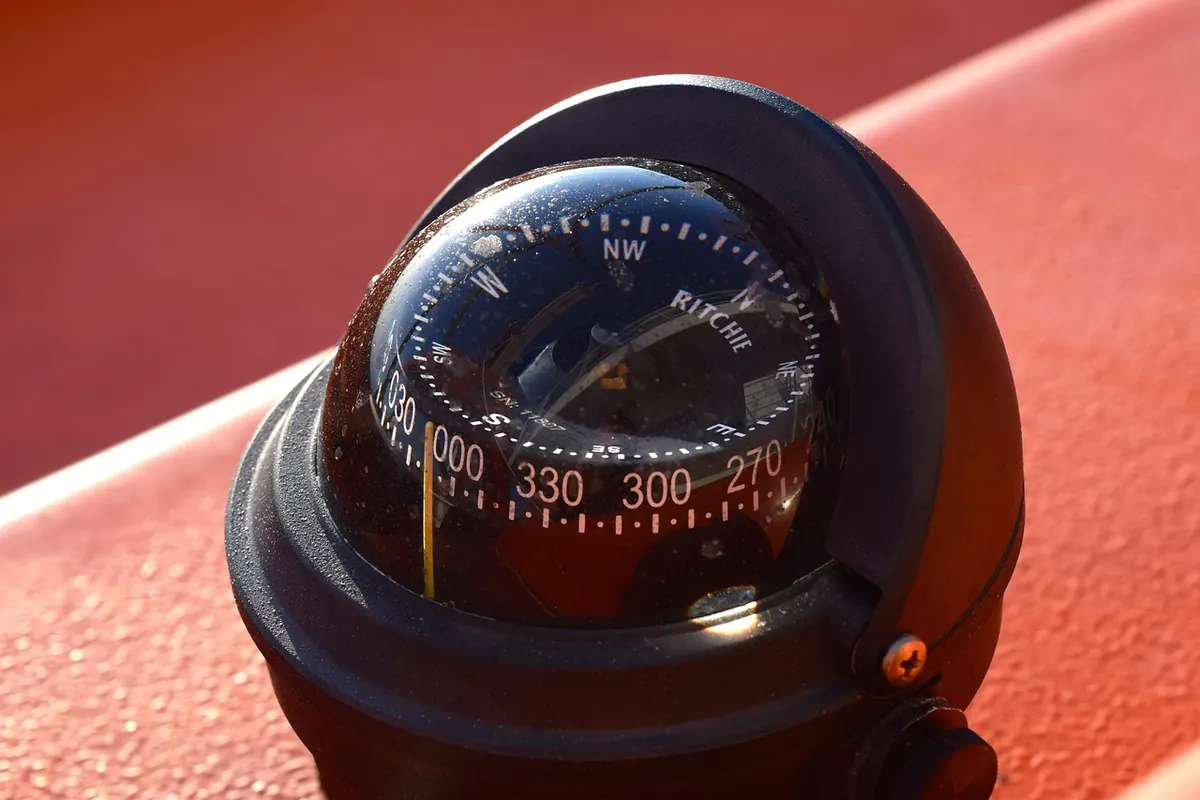
Before you sight anything, identify the parts of your compass. On a hand-bearing compass, there is a sighting notch or prism and a lubber line. On a baseplate compass, the direction-of-travel arrow and the index line do the same job. Know where to read the card before you are bracing yourself against a cabin trunk.
Set Up Before You Sight
Most bearing errors begin before the compass reaches your eye. A small boat is full of magnetic clutter: a phone in a pocket, a VHF clipped to a harness, keys, a knife, a speaker, a tablet case with a magnetic catch, winches, stanchions, and the engine block. Keep the compass well away from all of it. Even a few centimetres can make a difference with a sensitive card.
- Brace yourself properly. Sit or stand against the cabin, put your feet apart, and tuck your elbows in. If conditions and safety allow, reduce throttle or hold a steady course for a few seconds.
- Hold the compass level. The card needs to float freely. A tilted compass can drag or give a false reading.
- Keep your body between the compass and loose metal if you can. Do not rest the compass on a winch, rail, or chart table fitting.
- Check that the card settles and swings freely. If it looks sluggish, check for nearby metal or electronics before you blame the boat’s motion.
Sighting the Landmark, Step by Step
Choose a fixed object with a clear vertical edge or centre: a lighthouse, a church tower, a headland, a distinctive chimney, a transit mark. A buoy can work, but it rolls and swings, so treat it as a less steady target. The sharper the object, the better your bearing.
- Face the landmark and take up your braced stance. Hold the compass at eye level, not down at your chest where parallax and reflection can mislead you.
- For a hand-bearing compass, look through the sighting notch and bring the landmark into line with the lubber line. For a baseplate compass, point the direction-of-travel arrow at the object and keep the baseplate level; use the mirror if one is fitted.
- Keep both eyes open. One eye watches the object, the other watches the card. This sounds awkward at first, but it reduces squinting and helps you keep the compass steady.
- Let the card settle. Wait a second or two, and read at the steadiest moment rather than chasing the number as the boat rolls.
- Read the bearing at the lubber line or index line to the nearest degree. Write it down immediately with the object’s name, the time, and the boat’s heading.
- Take two or three readings. If they differ by more than a few degrees, check your stance, move away from metal, and try again. On a lively boat, an average of repeat readings is more trustworthy than one hurried number.
Reading and Recording Without Fooling Yourself
Read the card, not your memory. A bearing without a label is a trap: was that 074° compass, magnetic, or true? Write “C” or “M” or “T” next to the number, and note the object. “Lighthouse 074 C” is useful. “074” on its own is a puzzle for your future self.
Watch for parallax. If your eye is off to one side of the sight line, the card can appear to read differently. Keep your eye centred and the compass level. Also be careful with close objects; a nearby headland gives a more stable line than a distant feature that fades into haze.
A bearing you cannot repeat is a guess, not a fix.
If the boat is swinging at anchor, take the bearing when she pauses at the end of a swing, or take several readings and note the spread. A three-degree wobble is normal on a small boat. A twenty-degree spread means something is wrong: your stance, nearby metal, or the object itself. Reset, move clear of the electronics, and repeat the sequence. A steady spread is useful information; it tells you how much trust to place in the number.
Correcting for Variation and Deviation
Once you have a clean compass bearing, do not plot it straight onto the chart. The card points to magnetic north, while the chart is drawn around true north. The difference between them is variation, and it changes with where you are. On a small boat, variation is usually shown on the chart as a compass rose with a note giving the annual change. Read it before you leave the dock, or check the rose when you plot.
Deviation is different. It is the error caused by the boat’s own magnetic field and nearby equipment. A handheld compass held clear of metal may have little deviation, but a compass mounted near the helm or electronics may have a few degrees. If you are using a handheld compass away from the boat’s fixtures, you can often treat deviation as small, but do not assume it is zero. A phone, a speaker, or a winch handle can create a local error that vanishes when you move your hand.
Do the correction in a fixed order. Go from compass to magnetic, then magnetic to true. If variation is west, add it to the magnetic bearing to get true; if it is east, subtract it. For example, a bearing of 074° magnetic with 3° west variation becomes 077° true. Write the corrected number on the chart with a “T” so your future self knows what it is. If you are working back from a chart bearing to a compass bearing, reverse the steps.
Using Two Bearings to Fix Your Position
One bearing is a line. Two bearings, taken from different objects, cross to give a fix. On a small boat, this is the practical payoff: you do not need a plotter and a rolling chart table to know roughly where you are. Pick two landmarks that are well separated, ideally at least 45° apart. If they are too close together, the lines cross at a shallow angle and a small error becomes a large area of doubt.
Take the first bearing, record it with the object and time, then take the second. Correct both to true and draw them on the chart from the objects. Where the lines cross is your position. If you can take a third bearing, so much the better; a small triangle at the intersection tells you the size of your error. On a choppy day, take the bearings as quickly as you safely can, or hold a steady course between sights. If the boat has moved a long way between readings, the fix will be loose.
A simple example: a lighthouse bears 074° C and a church tower bears 128° C. After correction, the true bearings might be 077° T and 131° T. Draw those lines back from the landmarks, and the crossing point is your fix. It will not be perfect, but it will be honest, and it gives you a physical check on the chartplotter.
The best way to make this ritual reliable is to practise it before you need it. On a calm day, take bearings on familiar objects, write them down, correct them, and compare the result with the chart. Then do it again with the engine running and a ferry wake rolling through. The numbers will not always be perfect, but the habit will be: brace, sight, settle, read, label, correct. That is what turns a small handheld compass from a pocket ornament into a useful navigation tool.
Photo: Ghinzo / Pixabay